
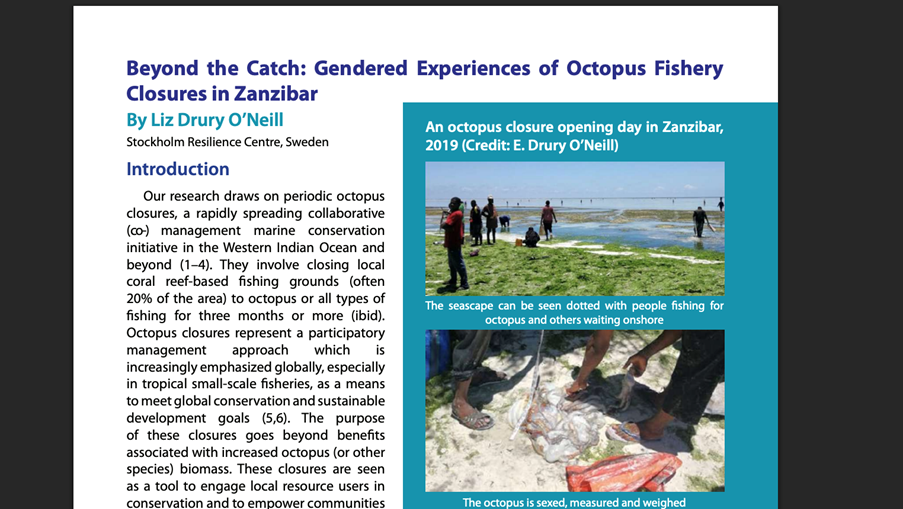
Based on:
- Drury O’Neill, Elizabeth, Tim Daw, Lorna Slade, Fatma Khamis, Salim Nassor Mbarouk, Jineth Berrío-Martínez, Andrew Wamukota, Rosemarie N. Mwaipopo, and Emilie Lindkvist. “Multidimensional Human Wellbeing in Periodic Octopus Closures in Zanzibar.” Ecosystems and People 20, no. 1 (December 31, 2024): 2412616. https://doi.org/10.1080/26395916.2024.2412616.
- Drury O’Neill, Elizabeth, Tim M. Daw, Mwambao, Rosemarie N. Mwaipopo, and Emilie Lindkvist. “The Complexity of Compliance—Diverse Responses to Octopus Fishery Closures in Zanzibar.” People and Nature n/a, no. n/a. Accessed November 4, 2024. https://doi.org/10.1002/pan3.10742.
Introduction
Our research draws on periodic octopus closures, a rapidly spreading collaborative (co-) management marine conservation initiative in the Western Indian Ocean and beyond (1–4). They involve closing local coral reef-based fishing grounds (often 20% of the area) to octopus or all types of fishing for 3 months or more (ibid). Octopus closures represent a participatory management approach which is increasingly emphasized globally, especially in tropical small-scale fisheries, as a means to meet global conservation and sustainable development goals (5,6). The purpose of these closures goes beyond benefits associated with increased octopus (or other species) biomass. These closures are seen as a tool to engage local resource users in conservation and to empower communities to better organize themselves within this sphere (e.g. creation of committees, developing local bylaws, engaging with environmental education).
While research on octopus closures often focuses on the ecological and economic impacts of these closures, our two recently published papers explore closure affects via (non-)compliance and multidimensional ideas of wellbeing from a qualitative interpretive perspective (7,8).
Background to the case
We worked in Zanzibar, a semi-autonomous archipelago off the coast of Tanzania with a history of traditional octopus (and fishing-ground closures more generally) and, like much of the Western Indian Ocean, where women have been the historical octopus hunters (9–12). Today octopus is both consumed locally and internationally exported, Zanzibari production has doubled since the 90s (13,14). Both women and men target octopus, usually during low tides, using low-tech tools such as wooden or metal sticks, hooks and spears. Women typically footfish or ‘glean’ while men can also snorkel/free dive along the reef edges (13–15). This reflects the broader WIO region, where in many places women access octopus only in the intertidal zone due to socially constructed rules, perceptions, and duties embedded in the various local cultures (16,17). They often don’t learn to swim or have access to fishing boats because of these gender expectations, thus larger octopus in deeper closed waters remain inaccessible on opening (1,2,14,18). Similar gendered roles flow downstream in the octopus value chain with differentiation of trading and processing roles between different types of actors i.e. locally based small-scale traderwomen (whom typically dry and fry for customers), larger-scale more capital rich tradermen (whom are typically mobile and linked to higher value markets e.g. tourism, export), smaller-scale tradermen (whom are often locally based but collect for the larger-scale male buyers) (19–21).
Theory & Methods
Our study of (non-)compliance (a topic chosen due to its importance across sites to research participants) draws on theory from sociology, anthropology and cognitive sciences and the subsequent theoretical framework was used to interpret how participants justified, were motivated by or dispositioned towards rules, rule makers and rule breakers (22,23). In our work on human wellbeing, a more holistic way to understand protected area impacts, we take a three-dimensional (material, relational and subjective) social wellbeing approach (24–26) to trace the flow of benefits, costs and burdens from closures at three sites in Zanzibar and explore how different types of fishers and traders perceive impacts. Using an intersectional lens allowed us to not simply focus on “women” but explore people’s intersecting relational structures (e.g. gender, value chain roles, livelihood strategies) which shape participants’ abilities to benefit from the closure and thus their wellbeing (27). Our data collection methods included storytelling circles, photo-elicitation tasks and focused discussions which prioritized participants’ emic descriptions and understandings of closures. In both papers we iteratively qualitatively coded data in MaxQDA.
Some Findings
A multidimensional wellbeing summary: Materially, all groups (fisherwomen, footfishermen, tradermen, traderwomen, skindivers) at all sites recognised benefits in terms of harvests at the openings of the fishery closure. By social group, fisherwomen cited the greatest material benefits, more easily meeting their basic needs. Tradermen experienced various market issues at material costs to them (e.g. low prices, illegal buying at opening). Material wellbeing costs to traderwomen were also linked to these market issues while for skindivers, the main octopus fishers, lost access to their fishing grounds. Relationally, all groups presented losses to a certain extent due to the conflicts, largely over non-compliance and largely by men, particularly at openings. Fisherwomen were particularly affected, as poaching reduced their fishing opportunities and strained relationships with those stealing from the closed areas. Gender relations were further impacted as the access and capture of benefits/resources associated with octopus landings were continuously appropriated by men e.g. skindivers going out to deeper reefs on opening days before appropriated time. Participants highlighted that there was no consideration/little consideration for other groups of people (elderly, children, women) and their differing access and capabilities in octopus fishing at opening events. Gender relations saw only little improvement with the recognition of increased representation of women in meetings and new opportunities to become guards. Subjectively, the female groups were the most satisfied with the resulting benefits that flowed their way e.g. incomes, nutrition-access, basic needs, benefits for children, community benefits, despite various costs to other wellbeing dimensions. Tradermen’s satisfaction was most evident around octopus sizes and abundances, important for them and their export market links. Conversely, skindivers and footfishermen were dissatisfied/upset by poaching and the fact that others (e.g. migrants, neighbours, guests) benefited from their closure.
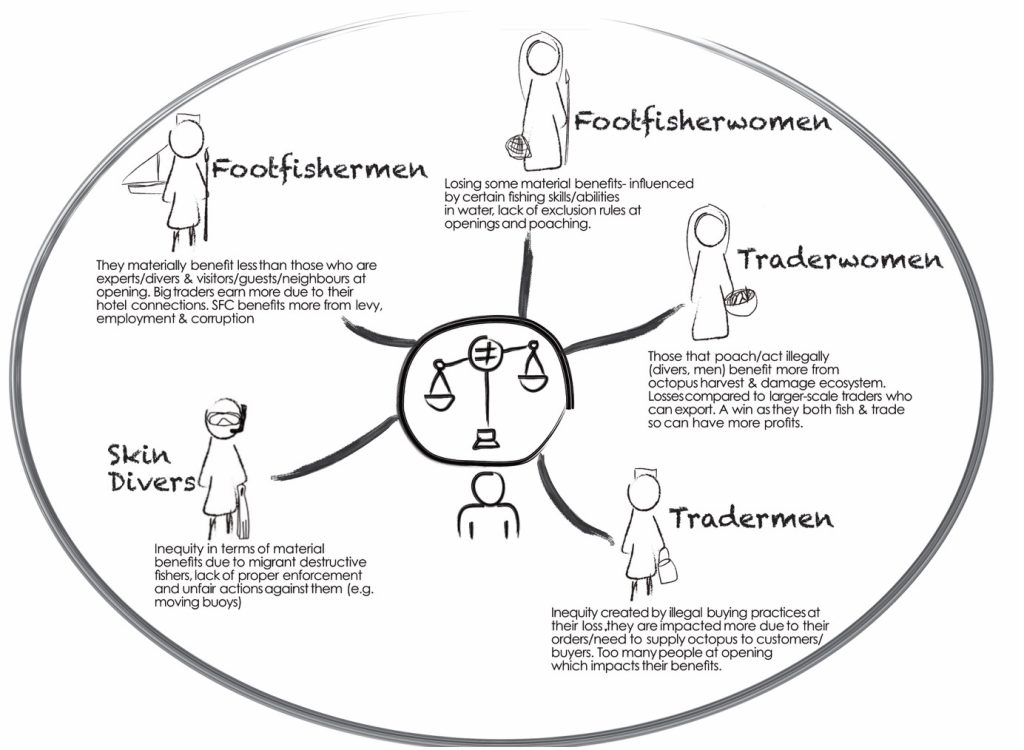
Inequity in the process: Questions of equity were extensively used to frame wellbeing impacts of the closure, at multiple levels and between multiple groups or types of people (See Inequity figure). Gender relations within the closure system often reinforced /deepened inequities between groups, for instance, younger men’s ability to access deeper waters during openings gave them an advantage in catching larger octopus. While the closures facilitated greater community involvement in decision-making, gender disparities persisted in participatory processes. Despite women’s higher attendance at meetings, their contributions were often limited due to relative-levels of education, societal attitudes that viewed them as passive attendees rather than active participants, and culturally ingrained norms that discouraged them from speaking out- the Shehia Fishing Committees, the primary local institutions responsible for implementing the closures, remained largely male-dominated. At opening events inequities most starkly emerged, between differently-abled fishing groups, between those locally-based vs visitors/outsiders, between larger-scale male traders and female traders (with limited access to markets, products and resources such as transport, credit or storage). It was during these opening times that wellbeing impacts were most felt by participants- from intense social conflict over broken rules to major boosts in catches (seen across periodic closures in Caledonia, Hawaii, Solomon Islands, Philippines, (28)), nutrition and deep celebratory happy interactions.
The gendered nature of responses to authorities, rules & (non-)compliance: Gender as a category, amongst many other axes of difference, was articulated by participants through their struggles with non-compliance and ability to benefit from the closure, for example ‘Men’ were blamed for non-compliance, evading meetings and the male poachers (the skindivers) in particular manifesting their ‘god given right’ to fish. In the Zanzibari context skindivers have a lower social status to fishermen with vessels (29) while at the same time, legislation at multiple scales (local up to national) marginalizes them by outlawing their main method (spear fishing) (30). Closure regulations target their main species (octopus) (31) while directly enabling others not previously engaged with octopus to benefit through the creation of opening events. Upon consideration, skindivers’ poaching could be seen as a token of resistance against unjust regulations or lost claims (32,33). The attention given to the Zanzibari skindivers by other participant groups as well as gender as a category more generally, in a non-compliance frame of reference, highlights the need to properly and meaningfully engage with ‘lower-status’ or unrecognized groups like Skindivers’, or footfisherwomen (20,34–36). Not doing so can mean unknowingly provoking non-compliance while increasing the burden on others’ shoulders, for example, for fisherwomen to provide School uniforms or fees through a diminishing fishing income as a result of overexploitation.
For a more in-depth discussion on gender relations within these topics see the two papers (7,8).
Key recommendations for enhancing the equity and effectiveness of octopus fishery closures
- Adopt context relevant conflict resolution strategies i.e. multistep formal and informal processes for resolving disputes, which recognise the nuances of conflict.
- Opening days should be managed extra carefully and accommodate different levels of specialization and/or types of engagement in the octopus fishery with specific exclusion or entry rules such as women-first or women-and-children-only areas, diver-designated reefs, visitor-only areas or times.
- Make time/space for open-ended qualitative discussions enacting active listening with smaller groups of people living at conservation sites (i.e. not just fishery organizations or leaders or larger “community” meetings) to gauge their feelings/interests/reactions to the process over time.
- Take the time to engage these smaller groups/different types of people living at conservation sites in environmental education and awareness raising of the benefits but also disadvantages of conservation.
- Manage with care and deliberation how people feel about the state/those who represent the state and thus how and where state actors engage with the conservation intervention.
- Make sure to publish or spread information on the different closure activities like apprehensions, fines, meetings for the creation of bylaws or rules in a fair and visible way e.g. bulletin boards, for more trust in implementers and increased agency for participants.
- Commit to connecting disparate groups, whom normally would not interact, for facilitated discussions on the intervention, with deliberate inclusion of lower ranking/less prominent groups e.g. the male skin divers, as a means to building social trust.
More Info
- For a video summary of the Compliance paper see here: https://www.youtube.com/watch?v=feeFBjen5F8
- For Stories written based on the research participant transcripts, see (37) and for information about a feedback trip where research was shared back to participants for validation in the form of a theatre play, and through workshops to practitioners and governmental actors see (38,39).
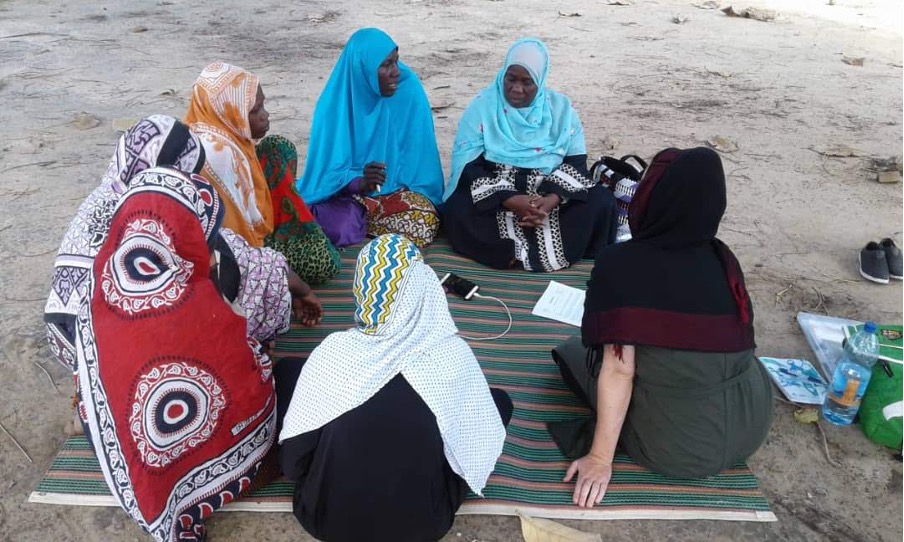
Story circles during data collection with octopus fisherwomen. Photo credit: E. Drury O’Neill
References
- Benbow S, Humber F, Oliver T, Oleson K, Raberinary D, Nadon M, et al. Lessons learnt from experimental temporary octopus fishing closures in south-west Madagascar: benefits of concurrent closures. African Journal of Marine Science. 2014 Jan 2;36(1):31–7.
- Oliver TA, Oleson KLL, Ratsimbazafy H, Raberinary D, Benbow S, Harris A. Positive Catch & Economic Benefits of Periodic Octopus Fishery Closures: Do Effective, Narrowly Targeted Actions ‘Catalyze’ Broader Management? PLOS ONE. 2015 Jun 17;10(6):e0129075.
- Rocliffe S, Harris A. Scaling success in octopus fisheries management in the Western Indian Ocean [Internet]. Zanzibar: Blue Ventures; 2015 [cited 2016 Apr 19]. Available from: https://blueventures.org/publication/scaling-success-in-octopus-fisheries-management-in-the-western-indian-ocean/
- Silas MO, Kishe MA, Mgeleka SS, Kuboja BN, Ngatunga BP, Matiku P. The octopus fishing closures positively impact human wellbeing and management success; case of Tanzania. Ocean & Coastal Management. 2022 Feb;217:106022.
- Basurto X, Virdin J, Smith H, Juskus R. Strengthening Governance of Small-Scale Fisheries: An Initial Assessment of the Theory and Practice [Internet]. Oak Foundation: Nicholas Institute for Environmental Policy Solutions at Duke University; 2017. Available from: https://www.issuelab.org/resources/28270/28270.pdf?download=true&_ga=2.262775813.84442305.1533057318-1280054509.1533057318
- FAO, editor. Voluntary guidelines for securing sustainable small-scale fisheries in the context of food security and poverty eradication. Rome; 2015. 18 p.
- Drury O’Neill E, Daw T, MWAMBAO, Slade L, Khamis F, Mbarouk SN, et al. Multidimensional human wellbeing in periodic octopus closures in Zanzibar. Ecosystems and People. 2024;
- Drury O’Neill E, Daw T, MWAMBAO, Mwaipopo R, Lindkvist E. The Complexity of Compliance – diverse responses to octopus fishery closures in Zanzibar. People and Nature. 2024;
- Mkumbukwa AR. The History of Use and Conservation of Marine Resources in Zanzibar: Nineteenth Century to the Present [Internet] [PhD]. [Bayreuth International Graduate School of African Studies]: Universität Bayreuth; 2014. Available from: https://epub.uni-bayreuth.de/3317/
- Rocliffe S, Harris A. The status of octopus fisheries in the Western Indian Ocean. London: Blue Ventures; 2016.
- Jack-Kadioglu T. Mtende and Kiwengwa Community Facilitated Historical Reef Closures. Zanzibar: MWAMBAO Coastal Community Network; 2017.
- Slade L, Breuil C, Greboval D. Working Paper on Scoping for Octopus management in Zanzibar. 2019;19.
- Sauer WHH, Gleadall IG, Downey-Breedt N, Doubleday Z, Gillespie G, Haimovici M, et al. World Octopus Fisheries. Reviews in Fisheries Science & Aquaculture. 2021 Jul 3;29(3):279–429.
- Berrío-Martínez J. Exploring complexities of fishery closures using octopus movements: an individual-based modelling approach [Internet]. [Sweden]: Stockholm Resilience Centre, Stockholm University; 2022 [cited 2023 Jan 18]. Available from: https://www.diva-portal.org/smash/get/diva2:1677919/FULLTEXT01.pdf
- Guard M, Mgaya YD. The artisanal fishery for Octopus cyanea Gray in Tanzania. AMBIO: A Journal of the Human Environment. 2002;31(7):528–36.
- Wosu A. The social-ecological dynamics of fisherwomen’s behaviour in northern Mozambique. [Internet] [PhD]. [Scotland]: University of Edinburgh; 2017. Available from: https://www.era.lib.ed.ac.uk/handle/1842/31249
- Wosu A. Access and institutions in a small-scale octopus fishery: A gendered perspective. Marine Policy. 2019 Oct 1;108:103649.
- Humber F, Harris A, Raberinary D, Nadon M. Seasonal Closures of No-Take Zones to promote A Sustainable Fishery for Octopus Cyanea (Gray) in South West Madagascar [Internet]. London: Blue Ventures; 2006 [cited 2024 Aug 13]. Available from: https://blueventures.org/wp-content/uploads/2021/03/seasonal-closure-ntz-promote-sustainable-fishery.pdf
- Drury O’Neill E, Crona B, Ferrer AJG, Pomeroy R, Jiddawi N. Who benefits from seafood trade? A comparison of social and market structures in small-scale fisheries. Ecology and Society [Internet]. 2018 Jul 23 [cited 2018 Jul 23];23(3). Available from: https://www.ecologyandsociety.org/vol23/iss3/art12/
- Fröcklin S. Women in the Seascape: Gender, Livelihoods and Management of Coastal and Marine Resources in Zanzibar, East Africa. 2014;
- Fröcklin S, de la Torre-Castro M, Lindström L, Jiddawi NS. Fish Traders as Key Actors in Fisheries: Gender and Adaptive Management. Ambio. 2013 Dec;42(8):951–62.
- Boonstra WJ, Birnbaum S, Björkvik E. The quality of compliance: investigating fishers’ responses towards regulation and authorities. Fish Fish. 2017 Jul;18(4):682–97.
- Cepić D, Nunan F. Justifying non-compliance: The morality of illegalities in small scale fisheries of Lake Victoria, East Africa. Marine Policy. 2017 Dec 1;86:104–10.
- Gough I, McGregor JA, editors. Wellbeing in developing countries: from theory to research. Cambridge ; New York: Cambridge University Press; 2007. 399 p.
- Johnson DS, Acott TG, Stacey N, Urquhart J. Social Wellbeing and the Values of Small-scale Fisheries. Springer; 2018.
- Acott TG, Johnson DS, Stacey N, Urquhart J. Reflections on Social Wellbeing and the Values of Small-Scale Fisheries: Implications for Research, Policy and Management. In: Johnson DS, Acott TG, Stacey N, Urquhart J, editors. Social Wellbeing and the Values of Small-scale Fisheries [Internet]. Cham: Springer International Publishing; 2018 [cited 2021 Nov 23]. p. 317–32. (MARE Publication Series). Available from: https://doi.org/10.1007/978-3-319-60750-4_14
- Galappaththi M, Collins AM, Armitage D, Nayak PK. Linking social wellbeing and intersectionality to understand gender relations in dried fish value chains. Maritime Studies. 2021 Dec 1;20(4):355–70.
- Cohen PJ, Foale SJ. Sustaining small-scale fisheries with periodically harvested marine reserves. Marine Policy. 2013 Jan 1;37:278–87.
- Woroniecki S. Challenging and Defending the Status Quo – The role of power relations for social-ecological systems transformation in MACEMP Zanzibar [Internet]. 2013 [cited 2021 May 4]. Available from: http://urn.kb.se/resolve?urn=urn:nbn:se:su:diva-91118
- The Revolutionary Government of Zanzibar. Zanzibar Fisheries Policy First Draft [Internet]. Smartfish; 2014. Available from: http://www.tzdpg.or.tz/fileadmin/documents/dpg_internal/dpg_working_groups_clusters/cluster_1/agriculture/2._Ag_policies_and_strategies/Zanzibar_Ag_policies/3._2014_Zanzibar_Fisheries_Policy__first_draft_-_18_June_2014_.pdf
- Sindano G. REPORT OF THE CONTROLLER AND AUDITOR GENERAL ON THE FINANCIAL STATEMENTS OF SOUTH WEST INDIAN OCEAN FISHERIES GOVERNANCE AND SHARED GROWTH PROGRAM (SWIOFish) [Internet]. Dar es Salaam: World Bank; 2019 [cited 2021 Nov 17]. Available from: https://www.google.com/search?q=SWIOFISH-Audit-Report-FYE-30th-June-2018&oq=SWIOFISH-Audit-Report-FYE-30th-June-2018&aqs=chrome..69i57j69i60.409j0j7&sourceid=chrome&ie=UTF-8
- Fabinyi M. Fishing in Marine Protected Areas: Resistance, Youth and Masculinity. In: Fishing for Fairness [Internet]. ANU Press; 2012 [cited 2021 Jul 11]. p. 149–70. (Poverty, Morality and Marine Resource Regulation in the Philippines; vol. 7). Available from: http://www.jstor.org/stable/j.ctt24h9fn.13
- Scott JC. Weapons of the Weak: Everyday Forms of Peasant Resistance. Reprint edition. New Haven: Yale University Press; 1985. 392 p.
- de la Torre-Castro M, Fröcklin S, Börjesson S, Okupnik J, Jiddawi NS. Taking gender seriously in natural resource management – an example using marine spatial planning in tropical seascapes. 2014 [cited 2016 Jan 10]; Available from: http://www.diva-portal.org/smash/record.jsf?pid=diva2%3A694549&dswid=2939
- Le D, Gill D, Pakiding F, Mascia M, Glew L, Ahmadia G, et al. Environmental Conservation and Social Equality: Distributional Impacts of Marine Protected Areas in Eastern Indonesia [Internet]. 2024 [cited 2024 May 22]. Available from: https://www.researchsquare.com/article/rs-3848635/v1
- Stiepani J, Jiddawi N, Mtwana Nordlund L. Social-ecological system analysis of an invertebrate gleaning fishery on the island of Unguja, Zanzibar. Ambio [Internet]. 2022 Aug 9 [cited 2022 Aug 17]; Available from: https://doi.org/10.1007/s13280-022-01769-1
- Storytelling Series [Internet]. OctoPINTS. 2021 [cited 2024 May 7]. Available from: https://octopints.wordpress.com/storytelling-series/
- Lindkvist E, Drury O’Neill E, Daw T. Open research feedback session by the OctoPINTS project in Zanzibar [Internet]. Stockholm, Sweden: Zenodo; 2022 Nov [cited 2024 May 7]. Available from: https://zenodo.org/records/7644714
- Drury O’Neill E, Daw T, Lindkvist E. A play of voices in marine conservation: Human experiences of fishery closures in Zanzibar. [Internet]. Stockholm Resilience Centre; Available from: https://octopints.wordpress.com/wp-content/uploads/2022/12/drury_oneill_et_al_play_script_2022.pdf