
Navigating the complexity of small-scale fishery interventions: An intersection of agent-based modeling and participatory empirical research
In this project we will dive into the octopus fisheries in the Western Indian Ocean and see how agent-based modeling can be combined with empirical participatory research to answer questions about trade-offs, benefit sharing, short- and long term social-ecological outcomes.
The livelihood and nutrition of millions of people are dependent on small-scale fisheries currently threatened by climate change and industrial development compounding challenges of overfishing, poor governance, and gender inequalities. To meet these challenges, communities and non-governmental organizations in East Africa are adopting periodic octopus closures as an innovative way to balance livelihoods and sustainability. The rapid growth and high value of Octopus provides quick payoffs, but how do these innovations enable communities to cope with pressures and shocks in the longer term? How do they change relationships between people and ecosystems? What is the impact for gender relations and equitable benefits?
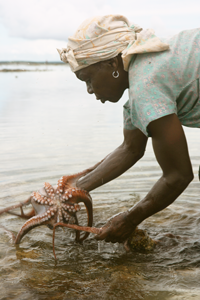
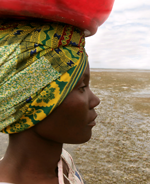
Octopus hunter. Photo by Adaoma Wosu.
This collaborative project harnesses the potential of co-developed social-ecological models and case studies to synthesize local expertise, understand key mechanisms, explore long- and short-term outcomes and socially differentiated impacts. The scientific novelty draws on the intersection of three emerging fields, the role of gender in small-scale fisheries , the use of agent-based models to explore social differentiation and resilience, and participatory approaches that support iterative, collaborative learning. The project will 1) develop transdisciplinary research feeding learning into intervention implementations through partners and broader networks and 2) identify key mechanisms that underlie sustainable outcomes in small-scale fisheries to move towards contextualized explanations of key sustainability issues.
Visit octopints.wordpress.com for more information
This work is funded through the research project grant “Sustainability and resilience – Tackling consequences of climate and environmental changes” funded jointly by the Swedish Research Council and Sida through the Swedish Government’s development aid funds, and by Formas’ and Forte’s research appropriations. With additional support from the Stockholm Resilience Centre, the University of Dar es Salaam, and the University of Pwani. Grant period 2019-2023.